

Alternatives to Ketamine for the 68W Combat Medic, Corpsman, Combat Paramedic, or Special Operations Combat Medic
You’re a 68W Combat Medic running a TCCC training lane, or even deployed, and have no Ketamine available due to logistical constraints (your favorite buzzword: LSCO.) Perhaps, you realize Ketamine isn’t working well for your patient and you want to consider another medication. This could also be for those who see the Tier 4 TCCC guidelines that mention Fentanyl IV / IO and want to learn more.
Are you comfortable enough with another medication or two to make things happen for your patient?
For the medics in our ranks with plenty of patient contact hours, such as our National Guard Flight Medics and NRP’s, this question is boring. However, to the novice active duty combat medics, Ketamine is often a “harmless easy button”, to the point it becomes a crutch. They can be less familiar with other medications, or even afraid of some like Fentanyl given IV. (Ketamine isn’t as harmless as many say, as referenced by our Ketamine Guide on our website.)
This article is a basic guide to help medics gain awareness of some other medications, how they can implement them, and links to references they can use to dig deeper on their own.
At the end, we will mention ways to include this in training. First, don’t go further or consider this article too much if you aren’t well versed in Ketamine, or even MARCH basics. We first need medics great at Ketamine and the basics. Then we add “bonus” to be able to be more prepared.
“I’m out of Ketamine?!?! I wouldn’t even know a second medication to consider.”
Here is a few suggestions, not all inclusive list, of medications for pain management that a medic can work on learning about after Ketamine. This article will focus on Fentanyl, and give you an idea of how you can look at the other medications.
- Fentanyl
- Hydromorphone
- Morphine
- Meloxicam (As per TCCC guidelines)
- Tylenol (IV) (Oral is in TCCC guidelines)
- Penthrox
- ….What would you add?
The novice combat medics guide to Fentanyl, for those with little to no experience with the medication:
Fentanyl is a synthetic opioid analgesic. Like most opiates, Fentanyl acts on the Mu receptors. Most non-synthetic opiates (Ie. Morphine) have some amount of histamine release which causes increased hemodynamic effects and vasodilation similar to anaphylaxis. Fentanyl, being synthetic, has not shown to have the same histamine effects, and thus being more hemodynamically protective and preserving cardiac stability. It is important to remember that ALL analgesics can cause hypotension. While some may be more hemodynamically friendly (Ie. Ketamine, fentanyl.), blunting the sympathetic response, pain, and anxiety of the patient can cause a decrease in blood pressure.
Fentanyl is an extremely potent medication. It is typically found in 50 mcg/ml concentration. 100mcg of fentanyl is equivalent to 10mg of morphine (up to 50-100x more potent). Fentanyl is usually dosed at 1 mcg/kg. A 100kg, hemodynamically stable person, could then receive 100 mcg of fentanyl. Fentanyl is metabolized through the liver, and is a good option for patients with kidney dysfunction (think kidney injury due to prolonged shock (poor perfusion) in the PFC environment). Fentanyl can be given IV, IM, and IN. Fentanyl has a rapid onset of approximately 2-5 mins depending on route. Fentanyl has a duration of action of approximately 1-2 hours with a peak pain control at 15-30 minutes. Fentanyl is eliminated in approximately 3 hours.
Patients in prolonged shock states (poor perfusion) or impaired liver function may not be able to eliminate opiates efficiently. Due to fentanyl’s relatively short peak pain control, large repeat doses may cause an increasing overlap and build up of medication in their system and may cause decreased mental status and respiratory depression. If given IV, Fentanyl should be administered slowly over 2 minutes. Fast pushes of fentanyl can cause nausea, vomiting, dizziness, and in extremely rare cases apnea, chest wall rigidity, and upper airway obstructions. Unlike Ketamine, opiates can be reversed with Naloxone in the case of respiratory depression or decreased mental status.
Typically, initial doses of Fentanyl should not exceed 100mcg. TCCC guidelines recommend 50 mcg IV pushes titrated to effect or 100 mcg IN. 50mcg is a safe starting point for most patients (depending on weight), and follow-on doses can be given in 25 to 50 mcg pushes. Some research tells us that 100 mcg may be safe in our sick trauma patients, but if you’re uncomfortable with the medication or your patient’s presentation, starting low and titrating up is always an acceptable treatment option. Some patients will handle large amounts of opiates and still be in pain, and some patients will get the appropriate weight based dosage and experience side effects or a drop in BP. Diligence in monitoring post admin is important in case you need to intervene or reverse the effects.
Ketamine acts on NMDA, GABA, and Mu receptors among many others. These actions cause the dissociative properties as well as the analgesic properties of the medication. Due to the difference in MOA, there is no partial-dissociative zone for Fentanyl. Studies have shown that using 0.2-0.3 mg/kg of ketamine (IV) vs 0.1mg/kg of Morphine (IV) had similar outcomes with pain control. 0.1mg/kg of morphine is equivalent to 1mcg/kg of Fentanyl. That would make 100 mcg (2ml [50 mcg/ml]) of fentanyl theoretically equivalent to 20-30 mg of ketamine. (0.4-0.6ml [50mg/ml] or 0.8-1.2ml [100mg/ml]). Where you may start with 20 mg of ketamine you may start with 50 to 100 mcg of fentanyl.
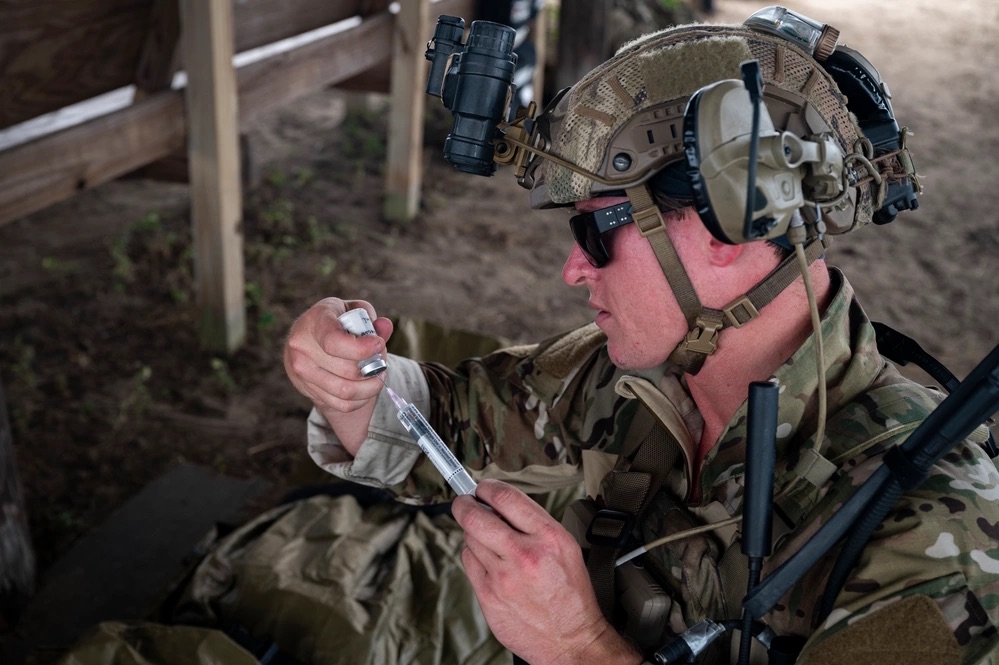
Example scenarios you can discuss with your junior medics and provider:
Scenario 1: A 220lb (100kg) soldier breaks his leg during a parachute landing. His vitals are stable and he hasn’t lost any blood, but he is in 10/10 pain.
– A starting dose of 100 mcg slow push may be appropriate, or you can give 50 mcg slow push and titrate 25 mcg “bumps” to effect if you’re concerned about side effects.
Scenario 2: A 175lb (80kg) soldier suffered a traumatic amputation after stepping on a landmine. Pt presents with bleeding controlled with a TQ, but is showing signs of compensated shock. Pt is in 10/10 pain.
– A starting dose of 75 mcg may not be appropriate since the Pt is in shock. A 25-50 mcg slow push starting dose with 25 mcg repeat pushes titrated to effect and BP may be more appropriate during the resuscitation.
Every good medic will go do their own education from a few sources to see variations in how things are done. Here is some additional reading to get spun up on Fentanyl and support above ideas without making this article exponentially longer:
- The Effectiveness of Ketamine Versus Opioids in Patients With Acute Pain in the Emergency Department: A Systematic Review and Meta-Analysis – PMC
- Fentanyl – StatPearls – NCBI Bookshelf
- Histamine-releasing and allergenic properties of opioid analgesic drugs: resolving the two – PubMed
- Ketamine Pharmacology: An Update (Pharmacodynamics and Molecular Aspects, Recent Findings) – PMC
- Analgesia and sedation for the critically ill patient – EMCrit Project
- Pharm 101: Fentanyl • LITFL • Top 200 Drugs
- Safety of prehospital intravenous fentanyl for adult trauma patients – PubMed
What would you add?
Implementing this into TCCC and Prolonged Field Care training:
This is an attempt to enable medics to become more versatile so Ketamine is not their pinnacle, or only anesthesia option. We should not be adding other drugs to the TCCC equation to medics who do not have strong fundamentals with Ketamine, or even MARCH. In the absence of patient exposure, this means knowing by memory the indications, doses, onsets, side effects and all, as well as properly implementing them consistently in TCCC trauma lanes.


Do you and your junior medics already have the ability to sling Ketamine in their sleep, perform a solid MARCH and perform excellent hemorrhage control and resuscitation?
Didactic training: Then you can introduce pushing their limits as simply as case scenarios on a white board; Ask them to calculate the dose they would give by drawing up from a normal saline vial how much they would give to a few scenarios. For the last rep or two, get a stopwatch out. If they can’t perform this in an air conditioned room, they can’t perform this during a TCCC lane. This can be done free with just expo markers and paper and pencils, or as cheap as tape or printed labels on saline vials and some syringes and needles. If not using on humans, can keep these syringes and refill to maintain trainers and do this training monthly with various meds. Remember to switch up the patients weights and concentration of vials (mcg/mL) so they don’t just memorize the mL’s to blindly push without checking.
Do they have an answer to above questions due to studying and training from above resources? You should be conducting TCCC training with saline vials that have fake medication labels on them, not just having them verbalize what they would give. You can include exposure to alternative pain management medications in TCCC trauma lanes (or PFC) by letting them know you are removing the Ketamine from a medics aid bag and to use or pack an alternative prior to the lane. Again, if they are not prepared to do this then this could be a waste of a training opportunity. You could also have them use Ketamine for their first few doses, and if they are performing well, could ask what they would use if they had to consider adding Fentanyl to Ketamine, or replacing Ketamine with it. This way they don’t have an entire trauma lane hinging on just one intervention. This works best with the vial so their hands on skills have to match their cognitive choices.

Common mistakes with meditation administration and training:
We can discuss guidelines and regurgitate them, but that doesn’t mean our students will apply them, even if they might know them. Here are some common trends you may see when running training using saline vials with fake medication labels. Keep these in mind if you are a medic or instructor, when training with Fentanyl, and all medications.
Improper dosing – As soon as a medics med box opens up in training, an instructor should be watching close. A combat medic may verbally say they are giving 50mcg and actually push 200-300mcg+ of fentanyl on their roleplayer/manikin. This can be exacerbated by a medic choosing a syringe size that is difficult to dose with. Proper syringe size can go a long way in helping. While diluting 1mL of fentanyl (or even Ketamine) into a 10mL syringe is an option, you could be asking someone without a ton of foundation to add even more calculations and duress. Once again, don’t make it exceedingly difficult if they are already struggling.
This may be a good lesson to bring a laminated card on person or drug box. Otherwise, on the worst days of your life when you are tired, hungry, concussed, a little sick and distressed by home life you can try to calculate something new from memory for your friend patient. We should have emergency drugs memorized, but also guides to help mitigate human errors when needed. Not cracking a book open for every papercut, but also having it available to back us up.
Pushing too fast – Some medics don’t train often on pushing medication or get frequent repetitions on real patients, unfortunately. Others don’t see value with pushing slow, so they slam their Ketamine and TXA over a second or two, maybe 10 seconds at the most. Fentanyl is a good chance for them to understand how long a push can be with an elevated heart rate. Instructors should pay attention to duration of the push and be able to give student or their patient corresponding feedback if it is rapidly slammed. This may mean the medic having to do some BLS, or choosing not to, if they even re-assess after administering the medication.
Improper instructor feedback – Yes, we do it to ourselves. Instructors who don’t know about Fentanyl themselves will give a patient “overdose” signs and symptoms like apnea or drastically lowered BP despite medic pushing an appropriate dose of 25-50mcg slowly. This can induce improper fear and training scars just due to ignorance or inducing stress. Don’t be giving extreme BP crashes or apnea to your students who aren’t pushing high doses and/or not pushing them rapidly. Students make enough mistakes on their own to graciously hand out hypersensitivity reactions.
Advanced: At minimum, medics should know a dose or range. Even better, is knowing a weight based dose, or tailoring a standardized dose due to patients size or status. A 140lb hemorrhagic shock patient may respond differently to 50mcg than a 240lb stable patient. Those are again, an escalation you can discuss with your provider on pushing training further to prepare for real life patients. This could be an entire different discussion, but a long term goal for newer medics to work on being a clinician instead of just pushing one number for everyone.
What about Fentanyl “Lollipops” OTFC? Those are no longer being produced. The point of this article stands, get familiar with Fentanyl in IV/IO.

What common issues do you see during the administration of medications during your medical training?
Comment below, or on our Instagram post of this article. Join our Discord if you want more discussions like this, or if you have ideas in how to mentor more medics. Reach out to us for any further questions.
 Next Generation Combat Medic