
MISSION: To develop on an ongoing basis the best possible set of trauma care guidelines customized for the tactical environment and to facilitate the transition of these recommendations into battlefield trauma care practice.
Review the latest guidelines below.


All Combatants | Combat Medic / Corpsman | SOC Paramedic
Click the links below to browse the NGCM supplements to TCCC
M – Massive Hemorrhage
A – Airway Management
R – Respiratory / Thoracic
C – Circulatory Support
H – Hypothermia Prevention
E – Eye Injuries
P – Pain Management
A – Antibiotics
W – Wound Care
S – Splinting
B – Burn Treatment
TBI – Traumatic Brain Injury
Posts about TCCC:
 14 Medical Lessons Learned from The Battle of the Black Sea that are Still True Today - Medical lessons learned have a habit of fading from memory as wars draw to a conclusion. Valuable knowledge can be lost if these hard earned lessons aren’t passed down to new providers. Below are 14 lessons learned from the 1992 battle which occurred in Mogadishu, Somalia, known today as the Battle of the Black Sea. […]
 4 Things You Should Do Before You Pack an Aid Bag - One of the most common questions we get on the Facebook page goes something like this: I’m getting ready to deploy soon. What should I pack in my aid bag? The answer is, as usual in medicine, “it depends”. There are many factors which play into what you carry in your aid bag. Here are […]
 A Lost Opportunity - A must read article for TCCC Instructors on how common mistakes ruin training.
 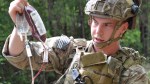 Blood Transfusions, Reactions, and More - This article was last reviewed in December 2018 and is based on research available at that time. We will attempt to update this page as new evidence and best practice becomes available. “Colloids and Crystalloids don’t carry oxygen or clotting factors. As Combat Medics we stop hemorrhaging, so it only makes sense to replace the […]
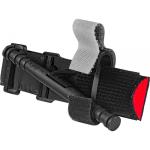 Buyer Beware: Selecting Your Everyday Carry Tourniquet - Source: Buyer Beware: Selecting Your Everyday Carry Tourniquet From Primary & Secondary By Andrew D. Fisher and Will G. With the increase in Active Violent Incidents (AVIs) over the last few years and the shared lessons learned (LL) from the U.S. and Canadian militaries’ experience in Afghanistan and Iraq, there has been an explosion of […]
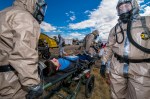 Chemical Agent Casualty Recognition Simplified - Recognition of exposure is the first step in the management of casualties exposed to chemical agents. As rapid recognition is essential for rapid implementation of appropriate therapy, cognitive processes to streamline presumptive diagnosis need to be considered.
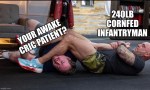 Cricothyroidotomy Training Guide for Military Medics: Ragged Edge of the Scalpel - Cric Training Guide for Military Medics and their Instructors
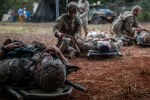 CTC Medical Survival Guide - This guide is mainly for medical Senior NCO’s and Officers to prepare their unit for a more successful CTC rotation (and subsequently, a deployment) while avoiding common mistakes. Junior 68W may gain information from this to prepare themselves, but success will come from getting your unit involved in training. “How could I better prepare for […]
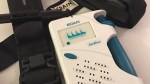 Do you use a Doppler for Bleeding Control Training? - Control of massive bleeding is all about achieving occlusion of the artery. This is the most important skill we can master as combat medics. Hemorrhaging is the leading cause of death on the battlefield, so we shouldn’t focus on airway, respirations, needle decompressions or other “sexy” interventions until we absolutely have “M” in MARCH mastered. […]
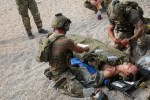 Enhancing TCCC through Optimized Simulation - A guide on how to teach better TCCC and run trauma lanes through designing patients, scenarios and providing feedback.
 Next Generation Combat Medic