
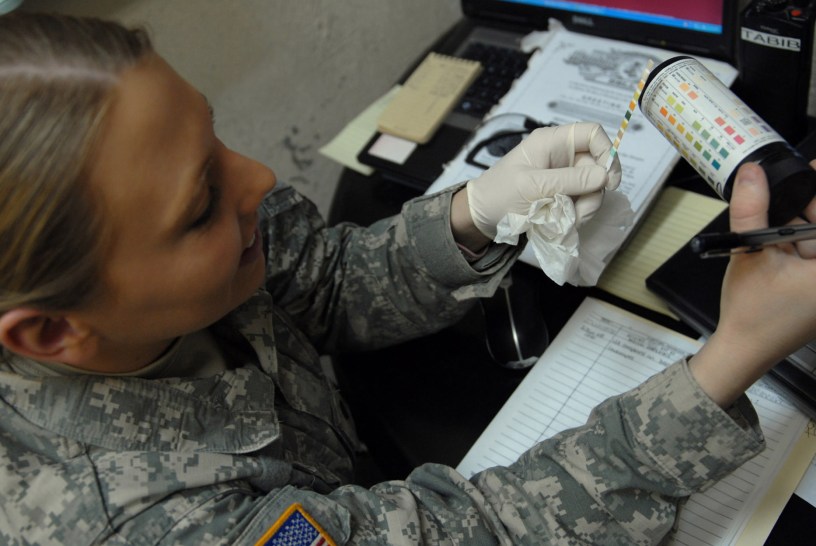
Trauma is more glamorous and very important to master. However, the most significant portion of your patients will Disease and Non-Battle Injuries (DNBI). Medics should know how to assess and treat these cases to maintain the fighting force. The ability to assess and recognize; treat, refer, or evacuate; and control pain and rehabilitate your patients is an important part of being a well-rounded medic.
Posts by Category
Sorted from head to toe
- General Assessment
- Neurological & Psychological
- Head, Eyes, Ears, Nose and Throat
- Dental
- Cardiovascular & Cardiology
- Respiratory
- Gastrointestinal & Genitourinary (GI/GU)
- Obstetrics & Gynecology (OB/GYN)
- Musculoskeletal & Orthopedics
- Dermatology
- Endocrinology
- Hematology & Immunology
- Chemical, Biological, Radiological, Nuclear, and Explosives (CBRNE)
- Infectious Diseases
- Preventive Medicine (PREVMED) & Force Health Protection
- Pediatrics
Recent Posts
 Anemia - This is an ongoing feature that will be updated daily until complete, check back often. Anemia is found worldwide, in fact, according to the World Health Organization (WHO), about 25% of the world’s population suffers from some sort of anemia. While you may only encounter a few types as a Combat Medic in the US […]
 Enabling Medics to manage Sick Call - Guide for PA’s and Senior Medics on improving Sick Call operations within their unit.
 Expired Meds: CAN You Use Them? - Scenario: You’re out in the field when an NCO approaches you about spraining his ankle during one of the last movements through some rough terrain. “It’s not that bad,” he tells you, “I just want some ibuprofen for the pain. Can you help me out?” You reach into your bag and pull out your favorite […]
 High and Sick: Altitude Illness - Note: types and dosages of medication used to treat altitude illness will be determined by your organization’s guidelines as authorized by your physician oversight. While this article does list medication doses, refer to your local treatment protocols for all care. You and your team are conducting patrol operations on Mount Rainier (14,411 ft summit), a […]
 Malaria: A Scientific Introduction - In 2018, malaria-infected an estimated 228 million people, killing over 400,000, disproportionately affecting the young and the poor (World Health Organization, 2019). Malaria is endemic to tropical and subtropical regions of the world, including parts of sub-Saharan Africa, Southeast Asia, and Central and South America (Suh, 2004). In 2003, the World Bank estimated that the […]
 Scenario: Back Pain with Thigh Numbness - A 38-year-old active duty male presents with sudden worsening of his chronic low back pain after trying to change a vehicle tire single-handedly while you are out in the field. He states that his back pain is accompanied by severe shooting pains going down his left leg to his calf, and that he feels like […]
- Sepsis in Austere Environments - There is a 30-50% possibility that severe infection will develop into sepsis. For the Deployed Med, c this means that a minor laceration can turn into a severe infection and eventually sepsis. According to the National Centre for Health Statistics, the annual incidence of sepsis in the USA rose by 7–8% per year over a period of 8 […]
 Train With Your Food: The Chicken Thigh Abscess I&D Trainer - As we’ve previously described, medical simulation equipment, while having a place in training, can be expensive and therefore unobtainable for units with a tight budget. Not wanting to deprive medics of good training ideas simply because of money jockeys and fiscal restraints, we here at NGCM continue to scour the literature and the internet, as […]
 Treating Diarrhea in a Remote Environment - One of the top killers worldwide is dehydration from diarrhea which counts for hundreds of thousands of deaths each year. Diarrhea and pneumonia are still causing 1.5 million deaths each year. During the Tropical Medicine and Infectious Diseases in an International Military Context conference, last week held in Hamburg, Germany one of the more interesting […]
 Next Generation Combat Medic